
Strip-and-Wax vs Burnishing: Maintaining Commercial VCT
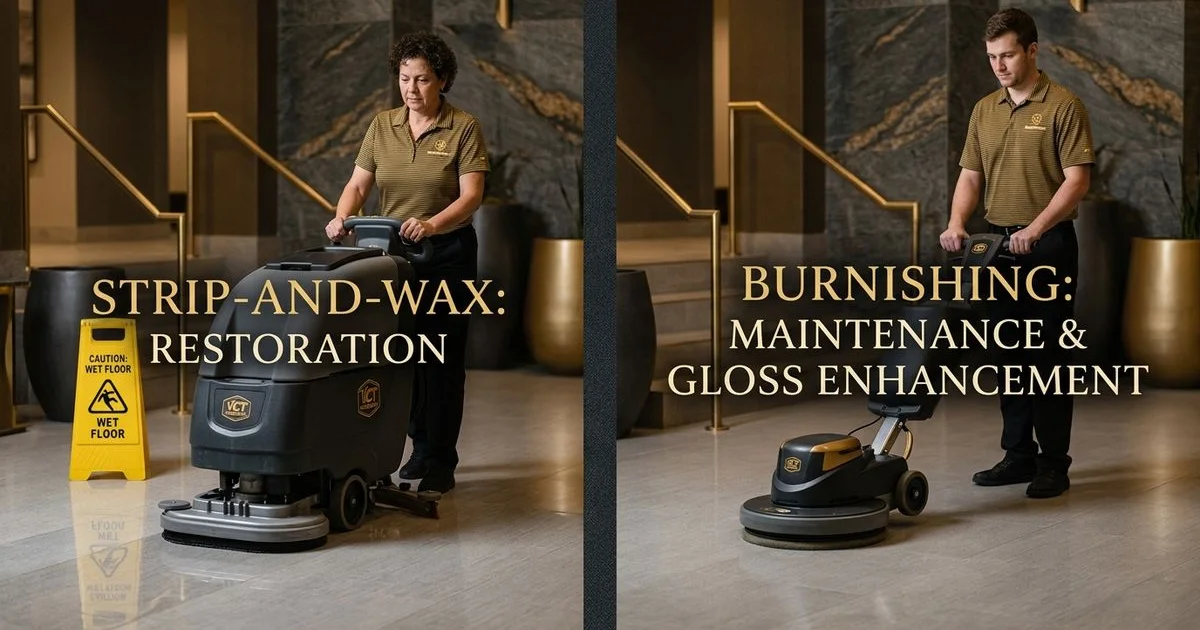
Facility managers and homeowners managing properties ask us almost every week: do I need to strip and wax again, or can I just burnish? When evaluating stripping and waxing vs burnishing VCT, the direct answer depends entirely on what each process actually does to the protective wear layer.
We see this confusion constantly across both residential stone care and commercial VCT maintenance. Managing floor care is a major financial decision.
For instance, a 2026 market analysis shows a full strip and wax in the US currently averages $1.72 to $2.15 per square foot.
Our goal is to help you minimize those heavy costs through proper maintenance timing. Let’s look at the hard data, explore what it is actually telling us, and map out practical ways to respond.
What full strip-and-wax does
Strip-and-wax is a complete reset of the floor’s finish that physically removes all old protective layers down to the bare tile. We initiate this intensive process using a standard low-speed floor buffer operating at 150 to 330 RPM. This specific speed allows the machine to aggressively agitate chemical strippers without damaging the underlying surface.
- All existing wax is chemically removed down to bare tile using a low-speed stripping pad.
- The floor is neutralized and thoroughly rinsed. Our technicians know that failing to neutralize the pH is the main reason new finish peels off.
- Four to five fresh coats of modern water-based urethane or commercial-grade finish are applied. Proper dry time between each layer is strictly enforced.
- The final coat is allowed to cure completely to create a maximum protective barrier.
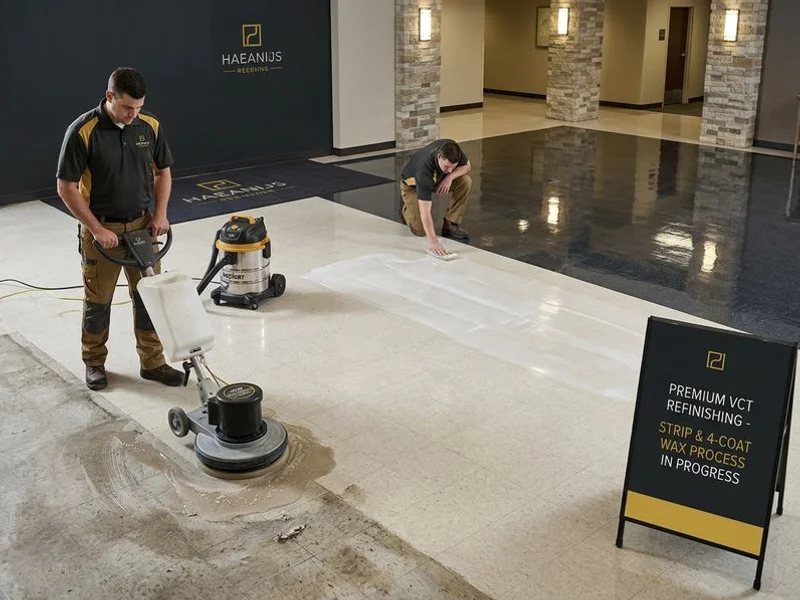
This complete teardown is the only effective way to remove yellowed wax, embedded dirt, and accumulated layers of old product. Our commercial clients often wait until the floor looks visibly amber before requesting this service.
Delaying this intensive reset will degrade the tile itself over time. A fresh strip-and-wax returns the floor to its maximum thickness of protective finish.
What burnishing does
Burnishing uses a high-speed buffer to generate intense heat and friction that polishes the existing top layer of wax. Our team typically utilizes specialized machines spinning at 1,500 to 2,500 RPM for this exact task. The friction physically melts the micro-scratches in the finish to restore a clear gloss without adding or removing wax.
We strongly warn against burnishing a dirty floor. Hitting embedded soil with a 2,000 RPM pad permanently melts that dirt directly into the wax layer. The surface must be flawlessly clean before the machine ever touches the ground to prevent permanent stains.
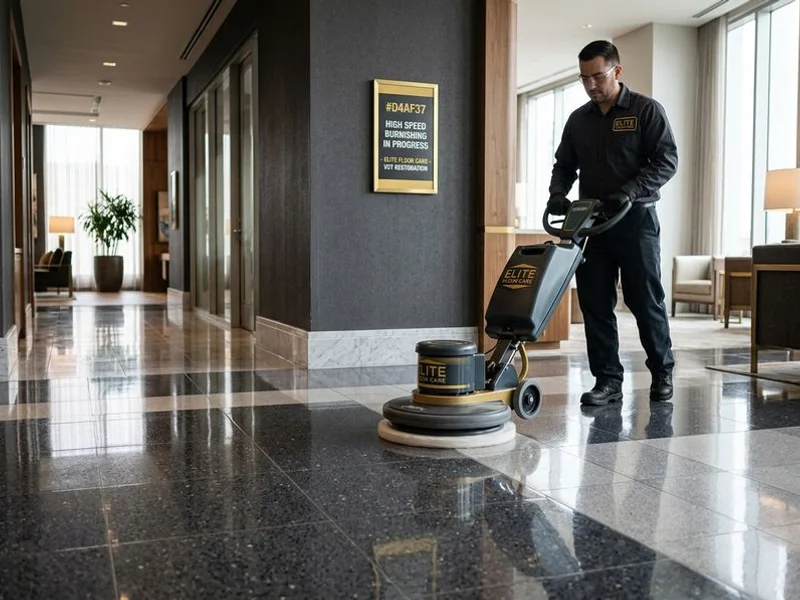
Burnishing is incredibly fast and quiet enough to perform during regular business hours. Our routine maintenance plans use this technique to dramatically extend the time between full strip-and-wax cycles. A quick polish is also a relatively inexpensive way to maintain high safety and slip resistance in busy commercial zones.
When to use which: Stripping and waxing vs burnishing VCT
Choosing the correct method requires a quick visual assessment of the floor’s current condition. We have organized the most common scenarios below to help you make a fast and accurate decision.
| Floor Condition | Recommended Action | Machine Speed Required | Average Cost Impact |
|---|---|---|---|
| Floor looks yellow or amber | Strip-and-wax | 150-330 RPM (Buffer) | High ($1.72+ per sq ft) |
| Floor is dull but clean-colored | Burnish | 1,500-2,500 RPM (Burnisher) | Low (Maintenance cost) |
| Visible bare tile in traffic paths | Strip-and-wax immediately | 150-330 RPM (Buffer) | High (Prevents tile replacement) |
| Gloss has dropped 30-50% | Burnish | 1,500-2,500 RPM (Burnisher) | Low (Restores wet-look) |
| Wax is peeling or flaking | Strip-and-wax | 150-330 RPM (Buffer) | High (Requires full reset) |
| Just need shine before an event | Burnish | 1,500-2,500 RPM (Burnisher) | Low (Fast turnaround) |
We always prioritize burnishing if the wax layer remains thick and healthy. Unnecessary stripping wastes money and exposes the base tile to potential chemical damage. The hard data confirms that a disciplined polishing schedule will push your expensive strip-and-wax needs out by several extra months.
Recommended cadence
A structured timeline is the secret to keeping resilient flooring looking brand new. Our standard maintenance schedule for Las Vegas commercial spaces accounts for the severe regional dust and sand. Gritty sand acts like sandpaper under regular foot traffic and rapidly destroys floor finish.
- Monthly burnish in high-traffic spots. This repairs the micro-scratches caused by tracked-in sand before they deepen.
- Quarterly burnish across the rest of the facility. A consistent 2,000 RPM polish keeps the protective barrier hardened.
- Annual full strip-and-wax for most standard facilities. Doing this yearly prevents the finish from permanently yellowing.
- Semi-annual full strip-and-wax for very-high-traffic spaces. Retail environments pushing heavy carts require this more aggressive reset.
See our VCT stripping and waxing service for a customized maintenance plan. We configure these plans based on your exact square footage and daily visitor counts. Deciding between stripping and waxing vs burnishing VCT comes down to proactive scheduling. Proper floor care guarantees a safe and professional environment for everyone entering the building.
Need this work done in Las Vegas?
Our certified technicians handle this professionally with full home protection and a free, no-obligation on-site estimate.
See vct stripping waxingCommon questions
Is burnishing the same as stripping and waxing? +
No. Burnishing polishes the existing wax to a shine. Stripping and waxing removes old finish and lays down new coats.
Can burnishing replace stripping and waxing? +
No, but regular burnishing extends the time between full strip-and-wax cycles.
How often should we burnish? +
For high-traffic floors, monthly burnishing keeps the gloss up. For moderate traffic, quarterly is usually enough.
Restore it, don't replace it.
Schedule a free on-site estimate from certified Las Vegas stone and tile technicians.